


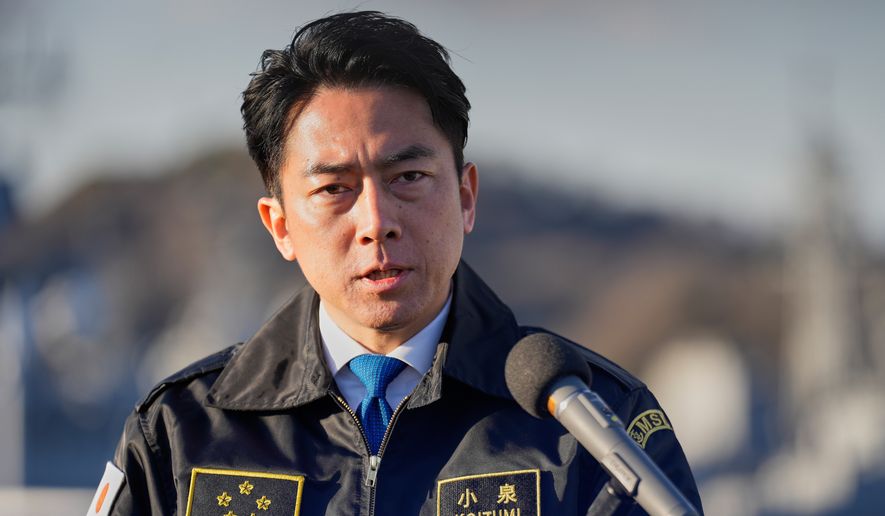

SEOUL, South Korea — Visiting Japanese Defense Minister Shinjiro Koizumi on Tuesday sidestepped a brouhaha that has galvanized Australian media — an apparent reference by the Australian prime minister to his Japanese counterpart’s breasts.
That may be a smart strategy; Mr. Koizumi, who many see as a future prime minister following in the footsteps of his father, Junichiro, is one of Tokyo’s key players.
Japan, home to an increasingly virile defense force and wary of China’s ever-increasing naval and military capabilities, is extending its reach to democratic middle powers around the region and beyond. Tokyo has used its relationship with Canberra as a benchmark to expand defense ties with London and Manila.
Unlike in Europe, there is no overarching NATO-style alliance for the Indo-Pacific region. Instead, regional democracies maintain separate, bilateral alliances with the U.S.
Mr. Koizumi left Australia on Tuesday for India on similar business, but his mission may not please Washington.
In a recent speech in Manila, U.S. Under Secretary of Defense for Policy Elbridge Colby warned regional capitals against “middle power alliances.”
Frigates, not melons
Asked on Tuesday if the “Melongate” scandal had arisen, Mr. Koizumi curtly responded, according to Australian media: “There was not such a discussion today.”
He admitted, however, that he was familiar with the controversy.
“Before I visited Australia, the Australian side had already told the Japanese side that [Australian Prime Minister Anthony Albanese] actually said that he did not really mean it that way,” Mr. Koizumi said.
In July, Mr. Albanese told the satirical podcast “Bushdeep,” hosted by comedienne Nikki Osborne, that Japanese Prime Minister Sanae Takaichi brought a gift during her May visit to Australia — “a royal melon … she brought, two, a couple of melons … and they were beautiful.”
Mr. Albanese’s comments and related hand gestures compelled Ms. Osbourne to ask if Ms. Takaichi was “like Pamela Anderson,” referring to the buxom U.S. actress.
The jocular back-and-forth was largely overlooked in Australia — until Japan’s former ambassador to Canberra labeled it a “sexist joke” last week.
Fueled by that remark, the episode went viral, generating a brouhaha nationwide. With the opposition demanding an apology, Mr. Albanese’s response was to deny any innuendo had been in play.
At a time when Australia-Japan defense ties are booming in the long shadow of China’s naval expansion and regional influence operations, national media were unimpressed.
“Anthony Albanese often makes a mistake,” National Editor of The Australian newspaper Dennis Shanahan told his paper’s news podcast, The Front, last week. “And his immediate response is to deny.”
While Tokyo officialdom stayed mum, the Australian Financial Review recorded pushback underway in Japan.
Social media users lambasted Australians as “citizens of a penal colony,” the Review found, and a Japanese reporter for the popular Asahi Shimbun newspaper posted, “There’s a difference between being friendly and being vulgar.”
Mr. Koizumi, however, refused to be drawn during a short meeting with Mr. Albanese. His main business in Canberra was to meet his Australian counterpart, Defense Minister Richard Marles.
The two agreed to allow Japanese military forces to use Australia’s vast firing and missile ranges for a decade, reviewed progress on a joint Australian-Japanese high-energy laser defense initiative and discussed the ongoing $10 billion acquisition by Canberra of a flotilla of Japanese Mogami-class stealth frigates.
Middle-power movements
It was Mr. Koizumi’s second visit to Australia in four months, speaking to ever-tightening defense ties.
In 2022, Canberra and Tokyo signed a “Reciprocal Access Agreement” enabling the deployment of troops and arms between the two nations. Japan used that template to subsequently sign deals with the United Kingdom and the Philippines.
“Japan is becoming less quasi, more ally,” wrote the Australian Strategic Policy Institute on Tuesday. “The term ‘ally’ makes sense even though the two countries still lack a treaty committing them to mutual defense.”
The Australian institute cited the Mogami deal and both countries’ ties to India, a democracy that also faces China-related security issues.
“With U.S.-India relations under strain, it’s incumbent on Australia and Japan to keep The Quad moving in the right direction,” the institute suggested.
Over the past year, India-U.S. ties, impacted by U.S. tariffs and Washington’s lean toward Pakistan as a dialog partner in the Middle East, “have experienced their sharpest turbulence in more than two decades,” wrote Indian media The Federalist on Tuesday.
The Quad — long form, “The Quadrilateral Security Dialog” — links Australia, India, Japan and the United States. Suggested as a formal body by the late Japanese Prime Minister Shinzo Abe – Ms. Takaichi’s mentor — in 2007, it has never expanded into an actual defense pact.
Australia and Japan “acknowledge that U.S. hard power is indispensable, and that the best way to keep any U.S. administration engaged in the Indo-Pacific is by showing Washington that its allies are willing to carry a fair share of the security burden,” the Australian policy institute advised.
This may meet mixed reactions at the U.S. Department of Defense.
On June 16, U.S. Indo-Pacific Command rebranded itself as U.S. Pacific Command. The term “Indo-Pacific,” widely used for regionwide defense spanning the Indian and Pacific oceans, had been coined by Abe in a speech in 2007. The U.S. military adopted the nomenclature during President Trump’s first term in 2018.
There are other signals of friction.
In a speech that notably did not include the word “China” and repeatedly sought to reinforce the trustworthiness of the Trump administration, Mr. Colby warned middle powers against creating alliances in a speech at the Stratbase Institute in Manila, Philippines, on Aug. 10.
He suggested “rejecting the delusion of fashionable but superficial ideas like middle power alliances designed to exclude America … such efforts by our allies and close partners should integrate and be complementary with America’s — not vainly and futilely seek to exclude or supplant us.”
Mr. Koizumi is expected to arrive Wednesday in India to meet Defense Minister Rajnath Singh, tour a naval base and discuss joint procurement and joint defense equipment projects.
His visit follows Ms. Takaichi’s visit to New Delhi in July.
Contact the author

Please read our comment policy before commenting.