



A version of this story appeared in the daily Threat Status newsletter from The Washington Times. Click here to receive Threat Status delivered directly to your inbox each weekday.
OPINION:
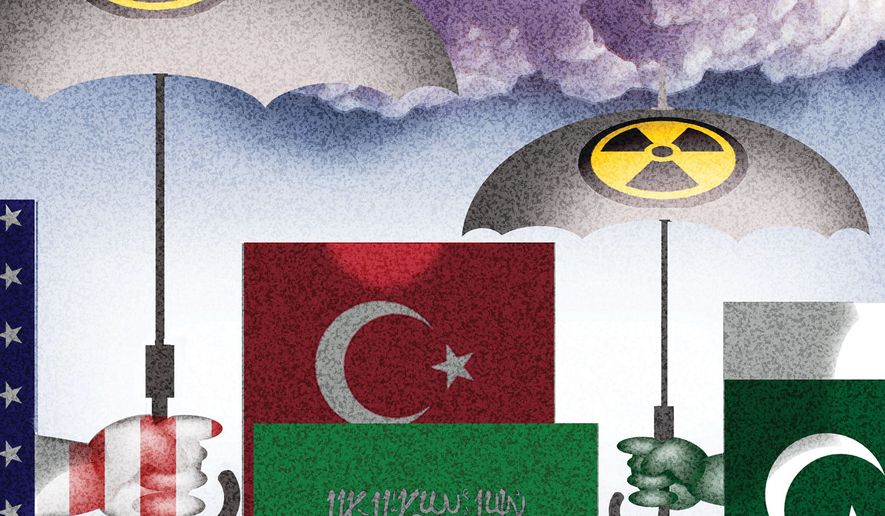
The new Turkish-Saudi-Pakistani mutual defense pact, or the “Mecca Joint Defense Agreement,” is a very curious pact. There are myriad issues arising from it, including its possible incompatibility with the NATO Treaty.
We know little about the treaty because the media – with the exception of the Wall Street Journal and this newspaper – has largely ignored it.
As this newspaper reported on Monday, Pakistan’s Foreign Minister Ishaq Dar said that other countries may join if they are willing to uphold the pact’s principles. According to the WSJ report, the Pakistani Foreign Ministry said, “The Agreement is intended to strengthen collective deterrence against any act of aggression, and stipulates that any armed attack against any one of the three States shall be regarded as an attack against them all.”
People were interested in these podcasts
That replicates Article 5 of the NATO Treaty. So what does it mean?
For one thing, it appears to be an effort to replace the American nuclear umbrella with another: Pakistan’s. So far, Pakistan’s nuclear weapons have been aimed at India – another nuclear-armed nation – but this agreement goes further. It brings together three Sunni Islamic nations against any adversary, especially Iran, that is a Shiite nation. No one can doubt that the three have Iran in mind.
It is also significant evidence that America’s protection under the NATO Treaty is in doubt for many reasons, including the Iran war.
The results of the war are of great concern to all three nations. They believe, with some justification, that President Trump is looking for a way out that might result in a stronger Iran. The new treaty brings that concern to a new height.
Our Saudi “allies” have always played a double game. They refuse, for example, to enter into the Abraham Accords until a Palestinian state is created, something that Israeli Prime Minister Benjamin Netanyahu says will never happen. Nor should it.
Our NATO “ally” Turkey is also playing a double game. Mr. Trump wants to sell it the F-35, the secrets of which could be easily passed to Russia and China. Turkey purchased the Russian S-400 anti-aircraft and anti-missile system in 2019. There is nothing to prevent it from testing the F-35 against the S-400 and giving the results to Russia and China.
Moreover, Turkish President Recep Tayyip Erdogan said in 2024: “No one can make us qualify Hamas as a terrorist organization … Turkey is a country that speaks openly with Hamas leaders and firmly backs them.” That puts Turkey in clear opposition to both the U.S. and Israel.
Pakistan has never publicly been an American ally. But behind the scenes, it allowed our land forces to go into Afghanistan following the 9/11 attacks and enabled our logistical corridor into Afghanistan under then-president Pervez Musharraf.
Today, Pakistan is fighting a cross-border war with the Taliban. But it is a long way from Pakistan’s border war with the Taliban to our fight against Iran.
The incompatibility of this agreement with the NATO Treaty stems from the fact that Mr. Erdogan would invoke Article 5’s mutual defense obligation if Turkey were attacked as a result of its membership in the Saudi-Turkish-Pakistani pact. We can take some solace in the fact that Turkey isn’t currently high on any nation’s target list.
NATO is weaker than ever. The European Union — whose membership list is almost identical to NATO’s — is still purchasing Russian natural gas, which is funding Russian President Vladimir Putin’s war machine in Ukraine. There is intelligence suggesting that Mr. Putin is considering an attack on a NATO nation within the next five years.
Whether Mr. Trump would respond to an attack on a NATO nation is uncertain, but he or a Democratic successor could easily plunge us into World War III. Mr. Putin will bide his time until Mr. Trump is no longer in office. If Vice President J.D. Vance, an isolationist, becomes commander in chief, he might refuse to intervene in a Russian attack on a small NATO nation.
What all this boils down to is that the three nations — Saudi Arabia, Turkey and Pakistan — are playing a double game intended to balance the protection of the United States against the protection of Pakistan. They are betting against the results of the joint U.S.-Israeli war against Iran.
But betting against Mr. Trump is one thing and betting against Mr. Netanyahu – or his possible successor — is quite another.
Mr. Netanyahu faces another election this fall. He could be replaced by as prime minister by someone, perhaps Gadi Eisenkot, a former chief of staff of the Israel Defense Forces. Nevertheless, neither Mr. Netanyahu nor Mr. Eisenkot could tolerate Iran’s development – much less its deployment – of nuclear weapons. They know that Iran will use these weapons against Israel at the first opportunity.
NATO is weak and the Saudi-Turkish-Pakistani alliance is open to new members. Some nations, betting against the results of the Iran war, could soon join.
• Jed Babbin is a national security and foreign affairs columnist for The Washington Times and a contributing editor for The American Spectator.
Follow the author

Please read our comment policy before commenting.