



A version of this story appeared in the daily Threat Status newsletter from The Washington Times. Click here to receive Threat Status delivered directly to your inbox each weekday.
SEOUL, South Korea — Two former officers in the Chinese armed forces have been arrested in South Korea on suspicion of spying on and around major U.S. bases in the country.
The men, both veterans of the People’s Liberation Army, are being held by police after allegedly spying on and around two key U.S. bases south of Seoul, in Gunsan and Pyeongtaek, according to a Tuesday report from Yonhap News Agency.
Yonhap reported that one of the suspects, a Chinese national in his 60s who has made multiple visits to Korea since 2024, was arrested for allegedly listening into aerial control tower communications around Gunsan Air Base (spelled “Kunsan” by U.S. Forces Korea).
People were interested in these podcasts
Police told the news service that the suspect’s visits to Korea coincided with major South Korea-U.S. exercises.
The other, a 45-year-old Chinese-Korean national who ran a military surplus store in the town of Pyeongtaek, reportedly recruited a South Korean female working at Camp Humphreys, situated on the edge of the town, to supply classified materials about joint war games.
His activities started in 2021, the reports stated.
Yonhap cited local police agencies for the details, but neither the names of the two suspects nor the dates or locations of their arrests were disclosed.
The men could face charges under the Communications Secrets Protection Act and the Military Base Protection Act, which carry penalties of fines or 3 to 5 years in jail. If found guilty of breaching the Benefiting the Enemy Act, they could face life sentences.
The timing of the news could prove diplomatically embarrassing. Chinese Foreign Minister Wang Yi is due to visit Korea for two days starting Aug. 19.
The locations of the alleged spying incidents are highly sensitive.
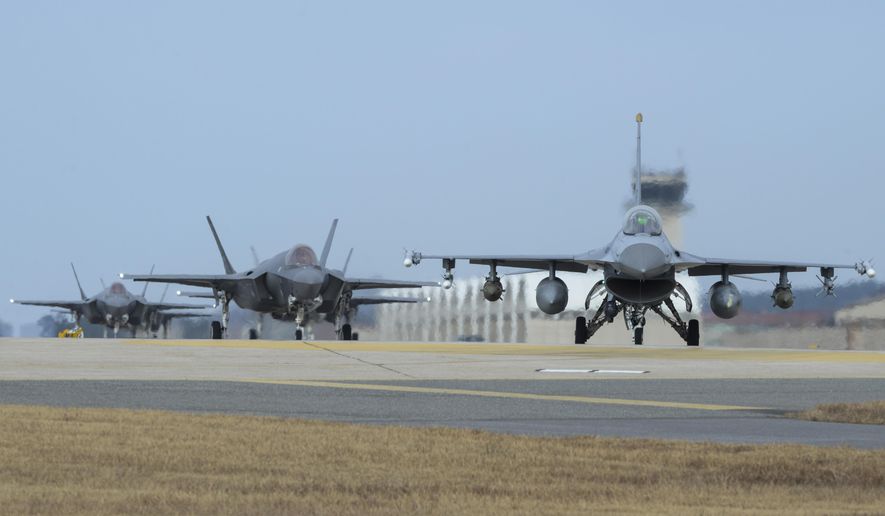
Gunsan, 114 miles south of Seoul, is home to the 8th “Wolf Pack” U.S. Fighter Wing and various support units, including air defense. The base has been in use by U.S. troops since 1949.
Camp Humphreys in Pyeongtaek, 64 miles south of Seoul, is the largest U.S. military base in the world outside the continental U.S. It has been the key hub of the U.S. armed forces in South Korea since 2018, after a series of major redeployments and consolidations.
It houses the headquarters of U.S. Forces Korea, the U.S. 8th Army, and assets including a signals brigade and an intelligence brigade.
Both bases, along with a third installation in the area, Osan Air Base, sit on or close to Korea’s Yellow Sea coast, offering U.S. troops excellent eyes and ears on that highly strategic body of water.
Key Chinese units, such as the PLA Northern Theater Command — one of five nationwide — and its naval component, the North Sea Fleet — one of three nationwide — are sited around the Yellow Sea’s Chinese periphery.
Chinese maritime installations on the Yellow Sea include surface bases, submarine bases and naval shipyards.
When former President Yoon Suk Yeol declared martial law in December 2024 via a nationalized television address, he cited Chinese espionage as one reason for his shock action.
Chinese persons had photographed a U.S. aircraft carrier in Busan Port, and the South Korean National Intelligence Service, he claimed. He accused the opposition, which controlled the National Assembly, of blocking his administration’s attempts to strengthen anti-espionage legislation.
Mr. Yoon’s martial law attempt was swiftly voted down. He was impeached and is now serving a life sentence for treason.
Beijing’s Foreign Ministry said at the time it was “deeply surprised and dissatisfied” with Mr. Yoon’s comments.
His successor as president, Lee Jae-myung, who won an election landslide in June 2025, has sought to upgrade relations with China, while also maintaining traditionally tight defense and commercial relations with the United States.
Many supporters of the imprisoned Mr. Yoon believe that Beijing has engaged in electoral interference in South Korea, and protested the visa-free access for Chinese tourists, a policy instituted in 2025.
The temporary visa-free access period has since expired.
Yonhap’s story broke just four days after visiting overseas experts at a Seoul conference on religious freedom detailed how Chinese figures have cooperated in an “unholy alliance” with hardline South Korean Christians and Japanese liberals to combat conservative new religions.
Contact the author

Please read our comment policy before commenting.