



OPINION:
In a city consumed by politics and power, East Potomac Park offers a recreational respite for Washingtonians. On any given day, runners circle its perimeter, walkers take in the river views and golfers tee off at the affordable public course at its center.
The narrow peninsula where the Potomac and Anacostia rivers meet is not grand. It is not exclusive. And that is the point.
In 1897, Congress designated East Potomac Park to be “forever held and used as a park for the recreation and pleasure of the people.” For more than a century, it has served that purpose. Now that principle is being tested.
People were interested in these podcasts
President Trump wants to dramatically remake the park, expanding its golf course into a “world-class, U.S. Open-caliber course” and taking with it the trail that generations of Washingtonians have enjoyed, as well as (potentially) the historic cherry trees that draw visitors from around the world each spring.
Opponents, including me — a Washington-area runner who has logged hundreds of miles on the perimeter trail that would be eliminated — see the risks of turning a public amenity used by everyday Washingtonians into a destination primarily for the wealthy.
There is nothing wrong with renovating a dilapidated, 106-year-old public golf course. The problem arises when renovation becomes reinvention, when improving a public space means sacrificing the qualities that made it public in the first place.
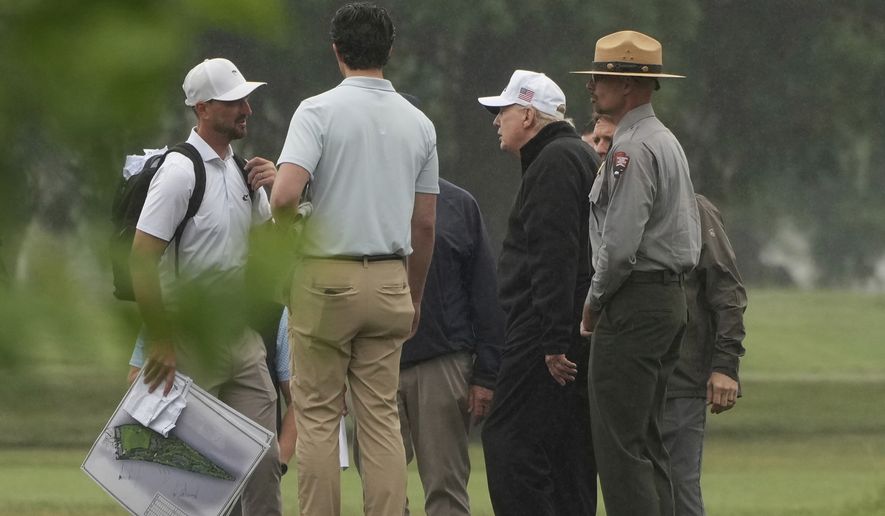
The project has advanced largely behind closed doors despite a lawsuit from the DC Preservation League and two local golfers seeking to preserve public access. The full scope of Mr. Trump’s plans emerged only after a photographer captured him carrying blueprints that showed an expanded course stretching to the banks of the peninsula.
Even Congress has been shut out entirely as the administration’s self-imposed Sept. 1 construction date approaches.
It’s become an all-too-familiar playbook: Develop grand plans behind closed doors, move quickly and rely on presidential authority to overcome public opposition.
Imagine a future president of either party unilaterally deciding that Yosemite National Park should become a signature development project or transforming another national recreation area into a monument to his or her priorities. Americans of every political persuasion would object if cherished public spaces became presidential canvases for their personal legacies.
Mr. Trump deserves credit for wanting to improve Washington. Several of his proposed investments could leave the region — like the recently announced $22.5 billion plan to modernize the aging Dulles International Airport — better than he found it.
But the way those projects are pursued matters just as much as the projects themselves.
Look no further than the proposed 250-foot-tall triumphal arch near Arlington National Cemetery. It drew more than 100,000 public comments during a 10-day period, overwhelmingly negative, and the National Park Service determined it could “adversely affect” 37 Washington-area historic sites, including the Lincoln Memorial and the U.S. Capitol. Yet the White House continues to advance it.
The administration also rushed a $16 million blue makeover of the Lincoln Memorial Reflecting Pool ahead of this year’s July 4 celebrations, only for algae to develop and the new liner to peel. After initial attempts to blame vandals, Jeanine Pirro, the U.S. attorney for the District of Columbia, admitted that the damage resulted from a botched installation.
That episode offers a cautionary lesson: The desire to quickly remake a Washington landmark can outrun careful planning and transparency.
East Potomac Park presents an opportunity to take a different approach.
The White House could fix the golf course within its existing footprint, keep it affordable for its current clientele and preserve the park’s trail, cherry trees and broader character as a multifaceted public space. Mr. Trump could still claim credit for breathing new life into a historic facility — earning a well-deserved feather in his cap — while ensuring that the public retains access to the park it has cherished for generations.
Mr. Trump’s best way to leave a lasting mark on Washington is to give the public a meaningful voice, listen when a proposal is unpopular and be willing to amend or abandon plans that do not serve the people who call this area home.
If he gets this project and the handful of others he has directed his allies to pursue correct, he’ll be remembered by the people who live here as the president who made their region better.
But if he gets them wrong, he risks breaking a longstanding understanding about Washington: The president is its steward, not its owner.
That is the dangerous precedent hidden in East Potomac Park.
• Evan Fallor is a policy communications professional and member of the Northern Virginia Running Club.
Please read our comment policy before commenting.