


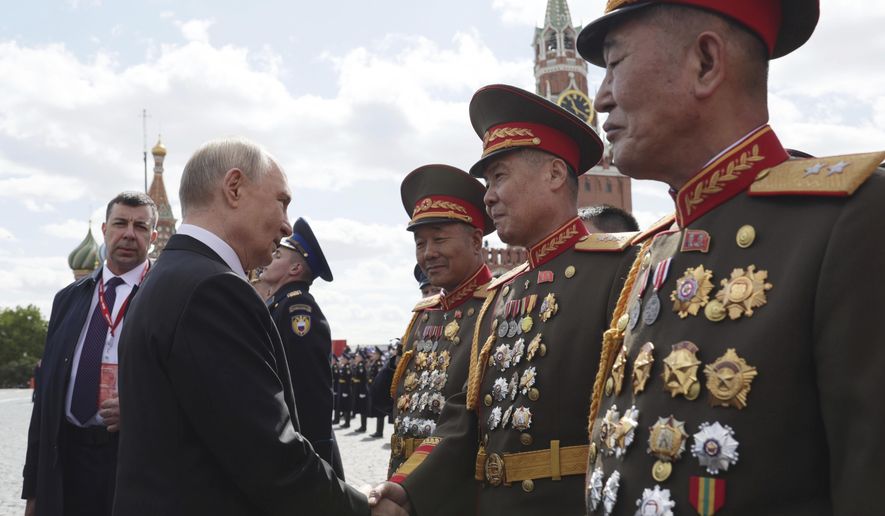

SEOUL, South Korea — The alliance between invasive Russia and ultra-militarist North Korea is spearheading a brutal world order for which a weakened West is unprepared, a leading expert says.
“North Korea is the only country able and willing to produce ammunition for Russia and is the only country which can essentially send their troops to the front line,” Andrei Lankov said. “North Koreans proved good soldiers, and I think this is only the beginning: They are likely to be very good once they learn more about the technologies of modern war.”
Mr. Lankov was born in Russia and studied at Pyongyang’s Kim Il Sung University in the Soviet era. He now watches the state from his professorial perch at Seoul’s Kookmin University, where he is followed by English- and Russian-speaking audiences.
People were interested in these podcasts
The bilateral partnership signed by Russian President Vladimir Putin and North Korean leader Kim Jong-un in 2024 is “purely transactional” but provides a “bonanza” for North Korea, Mr. Lankov said.
South Korean intelligence reports that North Korea has sent Russia as many as 12 million artillery shells. Consensus estimates of troops deployed are from 12,000 to 13,000.
That number is sustainable. According to World Population Review’s Military Size by Country 2025 report, North Korea fields the world’s fourth-largest army after China, India and the United States. With 1.28 million men under arms, North Korea is ahead of Russia, with 1.1 million.
Much of Pyongyang’s force is of low quality, but about 200,000 are considered crack troops.
Amid debate over the unity, or not, of the CRINK — the authoritarian axis of China, Russia, Iran and North Korea — ideology should not be overstated, Mr. Lankov said.
“The world that is seemingly emerging is very similar to the 1700s, a period when pretty much all alliances were marriages of convenience,” Mr. Lankov said. “Ideology played zero role.”
Mr. Kim’s deployment of North Korean troops to Russia may herald a cynical new business based on the model pioneered by the fearsome Swiss mercenary units of medieval Europe.
“North Korea will be able to make money by shipping regiments to friendly governments across the world,” Mr. Lankov said.
With large-scale, ultra-kinetic conflict returning, Moscow and Pyongyang are gaining combat experience that he said is superior to the West’s.
“Developed countries may need to fight, not the wars of the last half century, which were punitive expeditions to developing nations, but real wars which we wrongly believed to be a thing of the past,” he said.
Guns and butter
“For 60 or 70 years, North Korea was seen by Russians as a crazy place, and that reputation has not changed, but even if you have unsavory allies, you tend to have sympathy toward them,” Mr. Lankov told The Washington Times. “And North Korea is Russia’s only ally in this war.”
With millennial Moscow facing the isolation that North Korea endured for decades, new horizons are opening for Pyongyang.
“Given the inclination of the Russian government to avoid fighting a war with draftees, North Korea is extremely important,” Mr. Lankov said. “The Russian government understands that sending draftees into combat will seriously damage its popularity and support, which is remarkably high right now.”
Despite heavy casualties, North Koreans fighting in Kursk were assessed by Ukraine as fitter, more cohesive, more aggressive and better marksmen than Russian soldiers.
With the Kremlin offering increasing sums for contract soldiers, sending North Koreans also makes economic sense.
“We don’t know how much North Korea is paid for its soldiers, but you can be certain they are cheaper than Russian volunteers,” Mr. Lankov said.
North Korean troops have restricted themselves to Russian soil and have not fought in Ukraine proper. A Moscow source, speaking off the record, said that will likely continue.
“Putin does not want to use North Korean troops in Ukraine because that could open the door for NATO to send in troops,” he said.
Still, Mr. Kim’s troops can guard borders and installations, freeing Russians for operations, the source added.
However, Mr. Lankov reckons that North Koreans will fight inside Ukraine if the war drags on.
Indications of Russia’s repayments to North Korea are appearing.
Ukrainian sources note that North Korean ballistic missiles have become increasingly accurate, indicating the transfer of guidance technologies. Russia is also thought to be passing over drone manufacturing technologies.
Russian air defense systems have been identified in North Korea, with suspicions of gifts of naval propulsion and command suites.
North Korea, geographically ill-suited to agriculture, is also receiving food.
“On Russian blogs we see references to Russian chocolate, canned food and sausage in Pyongyang shops,” Mr. Lankov said. “On top of that, North Korea media are writing up the health benefits of wheat flour and baked goods,” indicating Russian supply.
Transportation links across the 7.4-mile-wide North Korea-Russia border are expanding.
“On top of the cross-border rail bridge linking the two countries, a road bridge is being built,” Mr. Lankov said, though roads on both sides of the border are rough.
After Russian Foreign Minister Sergey Lavrov’s trip to Wonsan this month, two weekly Moscow-Pyongyang flights were announced.
North Korea’s power grid does not use natural gas, but Mr. Lankov doubts Russia supplies much oil.
“Some is likely being shipped, but building a fuel line, which is expensive, is not being discussed,” he said.
That leaves Pyongyang reliant on Beijing for fuel, via a dedicated pipeline under the Yalu River.
The labor force is another area of activity.
Russia has announced plans to import North Korean engineering and labor units. With the Russian Far East underpopulated, civilian labor could be exported.
“North Korea can probably send 300,000 to 400,000 citizens,” said Mr. Lankov, noting that the Philippines earns significant foreign money from labor exports.
What next? “For the time being, Russia needs North Korea,” Mr. Lankov said.
He doubts Kyiv or Moscow can indefinitely sustain their intensity of operations, and he said Ukrainian resistance might suddenly collapse as Germany did in 1918. Alternatively, a lower-intensity, long-term stalemate might set in.
Regardless, he said, North Koreans and Russians are enjoying surprising prosperity, and both regimes are secure: Neither is likely to collapse.
“We have to see the world as it is, not as we want it to be,” he said.
The West will have to relearn “the ability to mobilize and to endure serious economic sacrifices,” he said, and recalibrate some liberal ideas.
Post-Cold War, “The West could afford to jettison the old ‘power-and-glory’ type of patriotism because the world was safe,” he said.
Now it needs to re-create strong shared identities, perhaps along Israeli or Turkish lines, he said.
“History used to be taught to create a sense of national pride with a touch of chauvinism, which was extremely useful if you believed your boys were going to be soldiers,” he said. “It was more propaganda than history, but I am afraid it was a necessary evil and is probably becoming a necessary evil now.”
Contact the author

Please read our comment policy before commenting.