



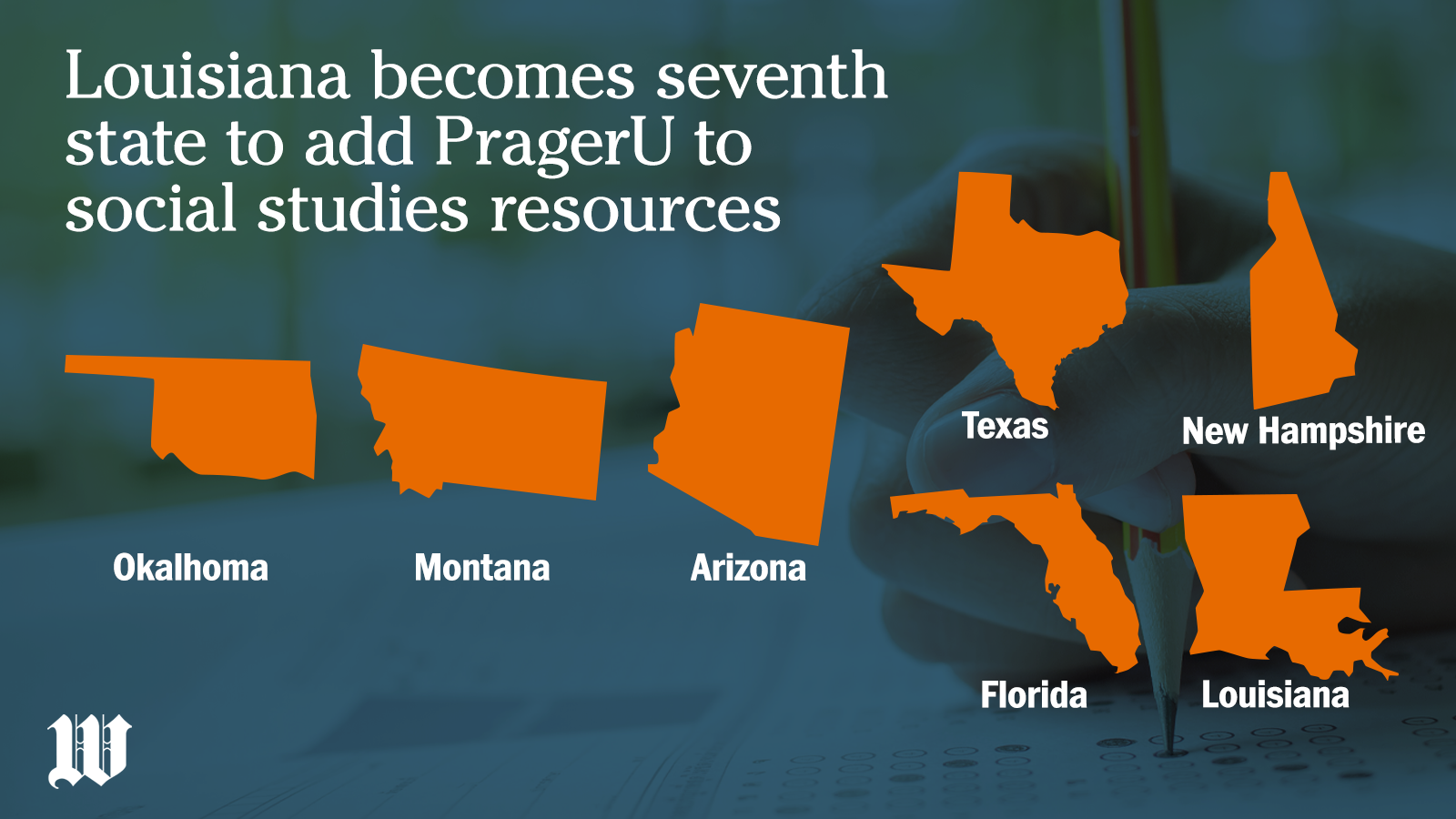
Louisiana has become the seventh state to adopt the conservative media platform PragerU as an optional K-12 social studies resource, bolstering a national parental rights debate ahead of the upcoming elections.
The PragerU Kids lesson plans, billed as patriotic alternatives to “woke agendas” in public schools, feature activists, including Candace Owens, hosting five-minute videos on topics such as the Pledge of Allegiance and the American bald eagle. Talk show host Dennis Prager founded the company, which is not an actual university, in 2009.
Officials at the Louisiana Department of Education said they decided to collaborate with PragerU on a “curated set” of videos after teachers in the conservative state started using the free materials independently.
People were interested in these podcasts
“Our state was one of the first to adopt a new, rigorous set of social studies standards based on American exceptionalism and our ongoing quest for a more perfect union,” State Superintendent of Education Cade Brumley told The Washington Times. “PragerU Kids completed a crosswalk of their videos to Louisiana standards, which could be very helpful for teachers and parents electing to use their supplemental materials.”
Education officials in Texas, New Hampshire, Oklahoma, Montana, Arizona and Florida have decided over the past year to approve PragerU Kids videos as supplemental resources.
Responding to The Times this week, some academics said Louisiana’s decision would promote basic civics knowledge and offer a wider range of viewpoints in left-leaning public schools.
“Allowing Prager’s material will move the balance in the direction of allowing students to hear from the other side as well,” said Walter Block, a libertarian economist at Loyola University New Orleans. “This will improve public education.”
Critics accused the state of angling to replace complex lessons on racism, immigration and poverty with a whitewashed “America First” narrative aimed at electing Republicans in November. They said PragerU videos have no place in classrooms.
“The most honest way to deal with it is to call them book burners who want to control what you read,” said James Carville, a Democratic Party strategist, longtime Louisiana resident and former political science lecturer at Tulane University. “It could hurt Republicans in November because extremism is the best case against them.”
Others said they would wait to see what teachers do with the videos.
“PragerU has a clear ideological angle,” said Brendan Gillis, director of teaching and learning at the American Historical Association. “But so do a host of other educational resource providers. What matters is the quality of the resources.”
Nevertheless, Mr. Gillis said he hopes most civics teachers will choose “trusted institutions” such as the Library of Congress and the Smithsonian Institution over PragerU for supplemental classroom lessons.
Legally, the seven states’ approval of PragerU videos as educational resources is largely symbolic. Public school districts, departments and social studies teachers still have the last word over the lessons and videos they use in class.
State officials said the videos cover many history, economics and civics lessons that are aligned with their newest learning standards. In recent years, Republican-led policy changes have called on schools to teach a more positive appreciation for American political institutions and the free market.
“Prager U offers high-quality educational materials focused on primary sources and the timeless principles of freedom and opportunity that the American Founders believed,” said Ryan Walters, Oklahoma’s state superintendent of public instruction and a former history teacher. “I am pleased to see state after state adopt these materials and get back to teaching true civics and history to our students all over the country.”
“PragerU Kids covers content such as civics and financial literacy,” said Brian O’Leary, communications director for the Montana Office of Public Instruction, which has recommended those subjects for all students.
State officials emphasized that the materials are optional.
“School districts can utilize PragerU Kids for supplemental materials at their discretion, along with a wide variety of other supplemental materials reviewed by FLDOE,” said Nathalia Medina, press secretary for the Florida Department of Education, which approved the videos last year.
“Our participation with PragerU is voluntary. No schools are compelled to use it,” said Doug Nick, a spokesman for the Arizona Department of Education. “Parents can access it for use at home, too.”
Culture wars
PragerU is expanding in conservative-state classrooms as more parents ask school libraries to remove books with “divisive concepts” about race and gender issues.
The American Library Association reported in March that public and school libraries experienced a record-high 4,240 individual challenges to books last year. Most targeted books on LGBTQ topics and racism.
Right-leaning parental rights groups say PragerU materials offer high-quality alternatives to the sexually explicit and politicized content that public schools have promoted for years.
“They are able to pack a lot of information in a short delivery, keeping in line with student expectations,” said Sheri Few, president of U.S. Parents Involved in Education. “It seems quite appropriate that public schools offer information from multiple perspectives.”
In recent years, school choice advocates have produced alternative K-12 resources and promoted them to teachers as “unbiased” alternatives to left-leaning materials on race, capitalism and transgender identity.
In addition to PragerU, such resources include Hillsdale College’s 1776 Curriculum and the Tuttle Twins franchise, which champions free markets.
Another is “The Story of America,” a distance-learning website that uses patriotic anecdotes from the bestselling books of Reagan administration Education Secretary William Bennett, who holds a doctorate in philosophy.
In a recent phone interview, Mr. Bennett praised PragerU videos for producing “honest, good and decent work.”
“Schools are one of the major battlegrounds in this election,” Mr. Bennett said. “If you frame it as our wanting an honest history that tells the truth, warts and all, it’s a winning issue for conservatives.”
Julie Collier, an eighth-grade English language arts teacher in a rural Oklahoma school district, said she has used PragerU’s “Street Smarts” videos with civics students. The videos feature interviews with children about the basic workings of political parties, impeachment, the Supreme Court and other fixtures of U.S. politics.
“The students enjoyed watching them and shouting out the answers based on what they learned,” Ms. Collier said. “It is also good for them to witness that kids their age are learning the same information across America.”
Some racial justice advocates have pushed back on the videos. They say the apolitical content has supported a quiet movement away from teaching the historical roots of racism against Black people.
“Prager is a sham organization for a sham process of rewriting and erasing history they don’t find acceptable,” said Omekongo Dibinga, a professor of intercultural communications affiliated with the Antiracist Research and Policy Center at American University. “Adding Black faces like Candace Owens, who is scrambling for validation from anyone who will accept her, doesn’t validate their anti-Black work and their work to whitewash history.”
Effective content?
Some historians have praised the PragerU Kids videos for their content, high production value, colorful graphics and upbeat music. Others question their effectiveness.
PragerU CEO Marissa Streit said the company launched its K-12 initiative in response to requests from teachers and school board members nationwide. She said the company does not know how many teachers have used the materials.
“At this point, we are not able to track the individual use of our content as our platform does not require teachers to log in or report back,” Ms. Streit said. “Anecdotally, we estimate that thousands of users will begin to engage with our free materials over the next 12 months as our website garners 27 million unique visitors per year.”
Arizona state officials have not tracked the use of PragerU videos in K-12 classrooms since adding them as an optional resource in January.
“This agreement came under immediate attack from [people on] the left who alleged that PragerU materials were dumbed down, whitewashed propaganda,” said Donald Critchlow, a U.S. historian and director of Arizona State University’s Center for American Institutions. “Whatever the case, the Arizona agreement was largely symbolic.”
Mr. Critchlow said the lack of follow-up confirms the videos have had little impact on the “poor civics education” students have received in recent years. He noted that most public schools now offer mandatory lessons in LGBT pride, Black history and women’s history.
According to the nonprofit civic research center More in Common, which favors a middle ground in history education between liberal and conservative concerns, PragerU’s expansion into public schools during an election year might do more to fire up conservative voters than change classroom culture.
“In a moment of sluggish policymaking, high news fatigue and low trust in government, voters may still be motivated to donate and vote by appealing to identity-focused issues that drive indignation and fear,” said Stephen Hawkins, More in Common’s research director.
Contact the author

Please read our comment policy before commenting.