



OPINION:
Hedge funds have found a new way to juice their returns: betting on lawsuits.
This practice is called third-party litigation funding, or TPLF, and it is a massive threat to our most important institutions.
According to a recent study by the nonpartisan Government Accountability Office, TPLF has exploded in the last few years. Under these arrangements, a financial backer — such as a hedge fund — will secretly finance and may even control a lawsuit in return for a share of any eventual settlement or award. Often, the defendant, the judge, and sometimes even the plaintiffs don’t know if a lawsuit has outside funding.
By treating our legal system as just another financial transaction on which to gamble, third-party litigation funding is making it harder for defendants to resolve cases and harder for plaintiffs to get justice.
Funding arrangements often end up doing more harm than good in a number of ways. For example, according to the GAO, TPLF carries a risk “that a funder paying for the litigation may exert control over the case (such as influencing decisions about litigation strategy or whether to settle).”
The risk is hardly theoretical. Consider how the food distributor Sysco recently sued Burford Capital, one of the world’s largest litigation finance firms, alleging that Burford stopped Sysco from accepting reasonable settlements in antitrust lawsuits that Burford had funded. Burford even obtained a temporary restraining order to block Sysco from accepting settlements and force the food distributor to proceed to a full trial.
Those who track the industry aren’t surprised at the details that emerged from the Sysco lawsuit. This gets to another problem the funding industry poses, especially in its current opaque form.
Funders have openly admitted their effect on litigation for years. The chief investment officer at the U.S. division of IMF Bentham Ltd., another major litigation finance firm, told The Wall Street Journal, “We make it harder and more expensive to settle cases.”
Litigation financing firms have every reason to drag out litigation, hoping to “hit the jackpot” at trial. After all, litigation finance firms often demand a high return from plaintiffs on the upfront legal fees that the financiers fronted — which means they may pressure (or prevent) a plaintiff from accepting an otherwise reasonable settlement offer.
The GAO also recognized that sovereign wealth funds could use TPLF to “influence litigation” to “further foreign policy or military goals.” Indeed, since funding agreements aren’t disclosed, there’s little to stop an unfriendly foreign government from employing third-party litigation funding to covertly influence our legal system in ways that compromise America’s interests. This form of foreign interference could be carried out on a massive scale without ever breaking U.S. law.
Despite the significant dangers this practice entails, third-party litigation funding remains mostly unregulated. Last year, by some estimates, litigation funders invested a whopping $3.2 billion in lawsuits throughout the country — a 16% increase from the previous year.
That figure is almost certain to keep rising in the years ahead — unless, of course, lawmakers and regulators take action. At the very least, those who engage in third-party litigation funding should have to disclose these financial arrangements.
Fortunately, members of both political parties and both Houses of Congress are beginning to take action. Last week, the House Oversight Committee, under the leadership of Chairman James Comer, Kentucky Republican, held a hearing to examine the numerous problems posed by unrestricted and unregulated TPLF.
The next day, Sens. John Kennedy, Louisiana Republican, and Joe Manchin III, West Virginia Democrat, introduced the Protecting Our Courts From Foreign Manipulation Act of 2023 to ensure that foreign sovereign wealth funds — including those controlled by China and other U.S. adversaries — cannot exploit our judicial system to the disadvantage of America’s economic and national security.
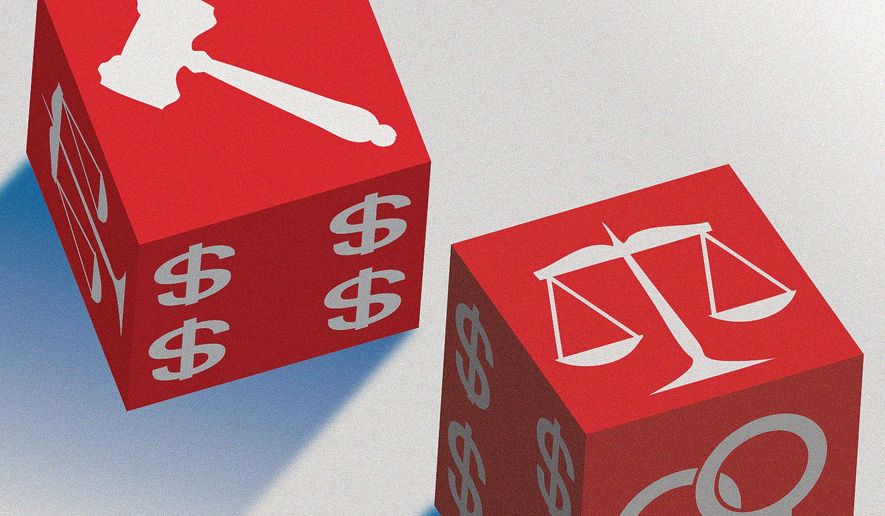
As former chairmen of the House Judiciary Committee, we believe that without significant reforms, outside funders will continue to use America’s courts as a veritable craps table. We should not let funders enrich themselves, harm plaintiffs, and damage our national interests at the expense of the integrity of our litigation system.
• Bob Goodlatte and Lamar Smith are former members of Congress and past chairmen of the House Judiciary Committee.
Please read our comment policy before commenting.