


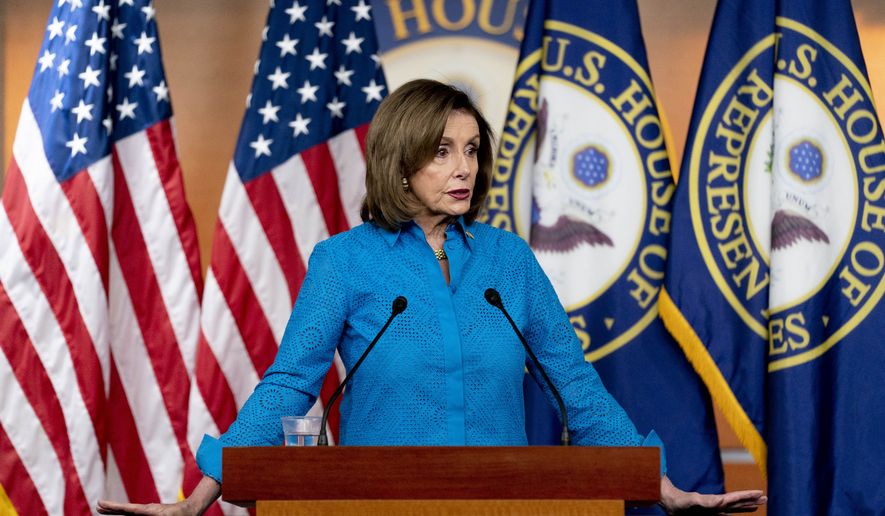

House Speaker Nancy Pelosi promoted congressional efforts to legalize and decriminalize marijuana as consistent with moves states have made on ending restrictions on cannabis.
The California Democrat said the move also would end injustices for people who have faced penalties for possessing the drug, largely communities of color.
“This is consistent with what’s happening with many states across the country, and it also addresses the injustices of it because of what penalties had been before some of these decriminalizations took place. I’m all for it,” Mrs. Pelosi told reporters Thursday.
People were interested in these podcasts
The House on Friday is expected to take up a bill that would eliminate all federal criminal penalties for the distribution and possession of marijuana.
The bill also would remove the drug from the purview of the Controlled Substances Act, which would legalize manufacturing and sales of marijuana.
The bill further mandates that judges review and reduce sentences for convicts currently serving federal prison sentences for marijuana-related crimes.
“This bill will not only put an end to harmful federal cannabis policies that have ruined countless lives, it will … reverse the damage by providing true equity and opportunity for those looking to access this booming industry,” said Rep. Barbara Lee, California Democrat. “We are on our way toward true justice.”
The bill would end the federal prohibition on marijuana but does not touch state laws on the drug, though states have been repealing or relaxing their marijuana bans for more than a decade.
Eighteen state have legalized recreational use of marijuana. Similarly, 37 states allow marijuana to be used for medicinal purposes.
Three states — Idaho, Nebraska and Kansas — still ban the drug for all purposes.
Outside of the criminal justice system, Mrs. Pelosi’s bill would impose a new excise tax on marijuana products produced or imported for commercial sale.
It further makes federally subsidized small business loans available for businesses selling marijuana and its related products.
The bill is expected to pass the House narrowly, much like it did in 2020. It faces long odds in the Senate, where bipartisan opposition is mobilizing.
Republicans and moderate Democrats say the bill goes too far. They note that the federal prison population constitutes very few individuals convicted for the possession of marijuana.
In 2017, for instance, 92 of 20,000 drug offenders were in federal prison for marijuana possession, according to the U.S. Sentencing Commission.
“I think this is a terrible public policy,” said Sen. Mike Rounds, South Dakota Republican. “I have not changed my position on it.”
Other lawmakers worry that legalization could make the opioid epidemic worse.
“I don’t support legalizing marijuana,” said Sen. Jeanne Shaheen, New Hampshire Democrat. “We’re in the middle of an opioid epidemic, and the research that I’ve seen suggests that that is a way that more people get into drugs.”
Opposition to the legislation is even coming from lawmakers representing states that have legalized the drug.
Democratic Sen. Jon Tester, whose home state of Montana approved the recreational sale of marijuana in 2020, says federal legalization would “cause more problems than it solves.”
While Senate Majority Leader Charles E. Schumer, New York Democrat, has pledged to bring the legislation to the Senate floor, it is unlikely to garner the 60 votes needed to overcome a filibuster.
Contact the author

Please read our comment policy before commenting.