



OPINION:
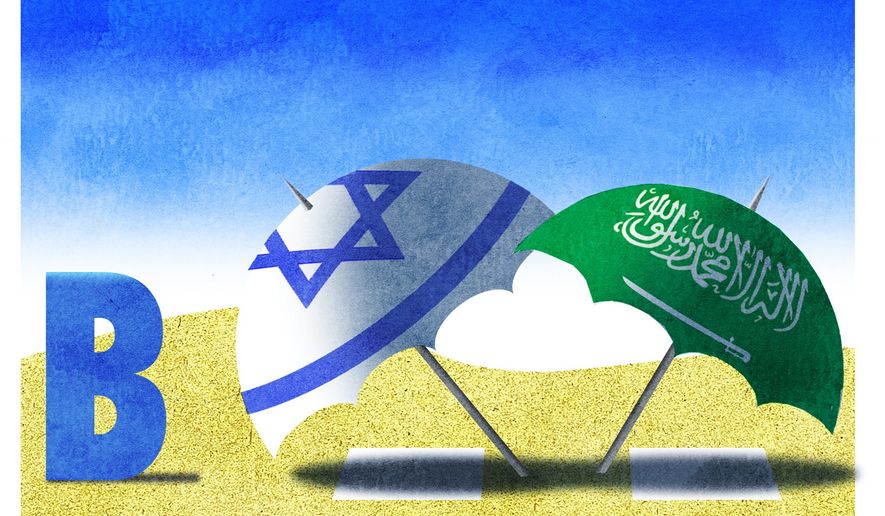
Having largely ignored the Middle East since taking office, President Biden is planning a trip to the region next month to meet with leaders of countries who don’t always want to follow the American line. Topping the agenda will be trying to repair relations with the Saudis and see if a Saudi-U.S.-Israel axis is possible.
Seeking to revive ties with Saudi Arabia — particularly with Crown Prince Mohammed bin Salman — Mr. Biden will try to achieve a peace agreement or normalization between Israel and Saudi Arabia which has thus far eluded all efforts. This was an element of former President Donald Trump’s 2020 “deal of the century” in achieving the Abraham Accords with the UAE and Bahrain. Where Mr. Trump at least had a strategy, Mr. Biden has no real vision.
Mr. Biden’s initial disinterest in the Middle East came as the U.S. withdrew its forces from Afghanistan and Iraq and demonstrated indifference to the Israeli-Palestinian conflict. At the same time the U.S. has had significant issues with Mr. Salman, suspended a deal to sell F-35 jets to the UAE, and sought to punish Egypt for human rights violations.
People were interested in these podcasts
As the Biden team tries to address all these issues, it is still unclear whether a new nuclear agreement will be signed with Iran in light of growing bipartisan opposition and ongoing Iranian attacks. The new Iran deal may be dead on arrival, and Mr. Biden has no alternative strategy if there is no agreement. There is no Plan B. Israel has made clear that it would not be bound by a new agreement and has revived plans for striking Iranian nuclear sites while improving its missile defenses.
The hope at the time of the Abraham Accords was that the Saudis would soon join — which has yet to happen. Media reports reflect closer Saudi-Israeli ties, most recently in economics and travel, making the Saudi-Israeli axis a center of attention in Israel and the Arab world. Saudi concerns about Iran make Israel the logical — and only — serious partner and member of the regional anti-Iranian coalition. This warming has largely been without U.S. input under Mr. Biden.
In 2020 then-Israeli Prime Minister Benjamin Netanyahu visited Saudi Arabia with then-Mossad Chief Yossi Cohen, and now Israel is considering a Saudi request to change the international status of two Red Sea islands, Tiran and Sanafir, claimed by Egypt, bringing Israel and Saudi Arabia close to their first public agreement. While largely an Egyptian-Saudi issue, a multinational force on the islands is required by Israel’s peace treaty with Egypt and is at the center of the talks between Israel and the Saudis.
While this requires amending the 1979 Camp David Accords, Israel does not oppose the transfer. Israel and the U.S. both hope to leverage this issue into a direct channel between Jerusalem and Riyadh. This might achieve some normalization, even if it falls short of a full peace agreement between Israel and Saudi Arabia.
In other signs of hope, the Saudis have agreed to direct investment in Israeli companies. Dozens of Israeli businesspeople have visited Saudi Arabia, signing deals worth millions of dollars and Israeli tourists now travel freely around the kingdom. Mr. Salman also is seeking to rehabilitate his reputation after the killing of journalist Jamal Khashoggi at the Saudi Consulate in Istanbul in 2018. He has become persona non grata in the U.S., has no ties in Congress and has yet to speak with Mr. Biden since the 46th president took office.
The Saudis might agree to a double normalization — with the U.S. and Israel. Representatives of Mr. Biden and Prime Minister Naftali Bennett are quietly working on this, but thus far there has been no news of an agreement in principle from any of the parties.
In other regional developments, Israel’s strained relations with Turkey have improved, as have their relations with both Egypt and Jordan. The Saudis have even held talks on restoring ties with Iran. In sum, these regional states all appear to have an overall strategy of reducing their reliance on the U.S., or showing that they are not always obligated to adopt the U.S. position.
Since Mr. Trump left office, the U.S. has had no integrated, coherent strategy where a Saudi-U.S.-Israeli warming can directly impact ties with Turkey, Egypt or Israel. These are all on separate tracks. Each of the regional states looks to its own interests vis-a-vis every other one, and only secondly in terms of the U.S., and then with the major powers, China and Russia.
The Biden team needs to engage in serious preparations to avoid a gaffe-filled fiasco that has characterized Mr. Biden’s previous overseas trips. This isn’t a time for yet more “clean up on aisle 6.” The Middle East is not the EU where the U.S. has a set of longtime allies with a common focus and purpose with ongoing coordination.
Mr. Biden will be facing a Middle East that has changed significantly over the past few years, with each of the regional states having concerns that need to be addressed if the U.S. is to play any significant role — within the region and impacting the larger world as well. More than a year has already been lost, and there is no time to waste getting on with the task.
• Abraham Wagner has served in several national security positions, including the NSC Staff under Presidents Richard Nixon and Gerald Ford. He is the author of the recent book “Henry Kissinger: Pragmatic Statesman in Hostile Times.”
Please read our comment policy before commenting.