


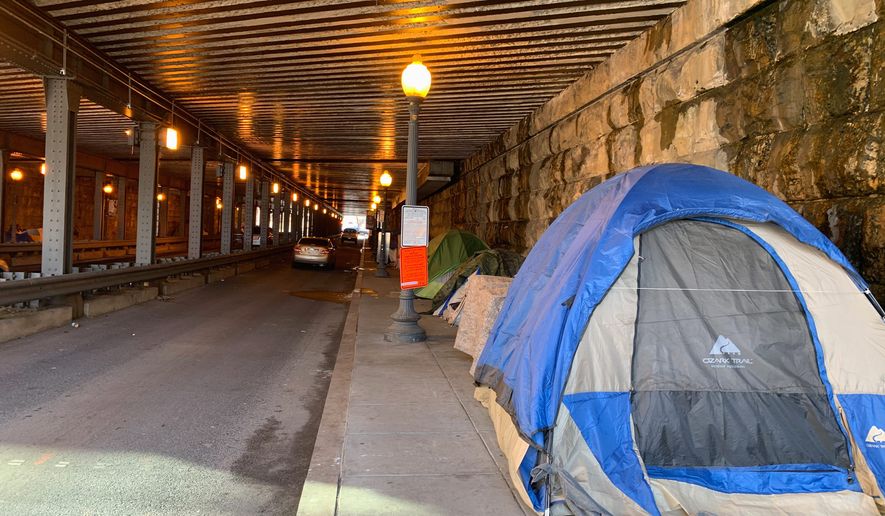

D.C. Council members acknowledged Wednesday the city agencies’ progress in reducing homelessness but questioned the methods they have used — particularly clearing an encampment of homeless people on K Street NE this month.
“Resolving the conflict that arose on K Street due to legitimate safety concerns from pedestrians passing by involved potentially decreasing the safety of those who have been trying to stay there,” Council member David Grosso, at-large independent, said in his opening statement. “This seems like using the same approaches, clearing out people, simply displacing the issue rather than getting to the roots of the issue.”
Wednesday’s hearing featured representatives of the D.C. Department of Human Services and the Interagency Council on Homelessness (ICH), and was lawmakers’ first public meeting on the topic since the encampment was cleared.
People were interested in these podcasts
Council member Trayon White, Ward 8 Democrat, asked ICH Director Kristy Greenwalt what to the people who were forced to move their encampment from under the K Street NE.
“I do know that a number had already been targeted for housing vouchers before the cleanup was enacted, some folks opted to move to L and M street and others left the area,” Ms. Greenwalt said, deferring specific questions to the Department of Human Services.
According to the city’s annual Point in Time survey of homeless people, families experiencing homelessness decreased 45% between fiscal 2015 and fiscal 2019, and veterans experiencing homelessness decreased 27% during that period.
However, the District recorded a 3% increase in homelessness among single adults between 2018 and 2019.
Mayor Muriel Bowser has set a goal of homelessness being rare, brief and nonrecurring this year.
To further reduce those statistics, the District is breaking ground on a men’s shelter on the St. Elizabeths Hospital campus. It will offer a variety of spaces and programs for different people experiencing homelessness. Other shelters are being updated.
Mr. Grosso pointed out that schools are reporting an increase in homeless youth. Ms. Greenwalt said the issue will be address by Solid Foundations, the city’s youth homelessness plan, and by Zoe’s Doors, a 24-hour center for people under 24 to get a meal, do laundry and connect to social services.
Many who testified during the Department of Human Services (DHS) portion of the hearing described how hundreds of residents stand in line for several hours to secure insurance through the D.C. Healthcare Alliance program, which helps people who don’t qualify for Medicare or Medicaid.
Program recipients must reapply every six months via face-to-face interviews with DHS employees at a service center. The council has passed legislation to remove the interview requirement, but Miss Bowser has not yet funded it.
“Imagine waiting outside in the biting cold for four to five hours just to get inside the service center and encounter a further wait to attempt to attain the health coverage to which you are entitled by law,” said Chelsea Sharon, an attorney at Legal Aid Society. “DHS may testify that people arrive so early because this is what they are used to doing. But we submit that people do not choose to line up at 3 or 4 a.m. out of habit; instead, they do so because it’s the only way to be seen by service center staff.”
Ms. Sharon added that the centers close half way through the day because they say they are at capacity, and many of the people in line don’t get seen anyway.
Please read our comment policy before commenting.