


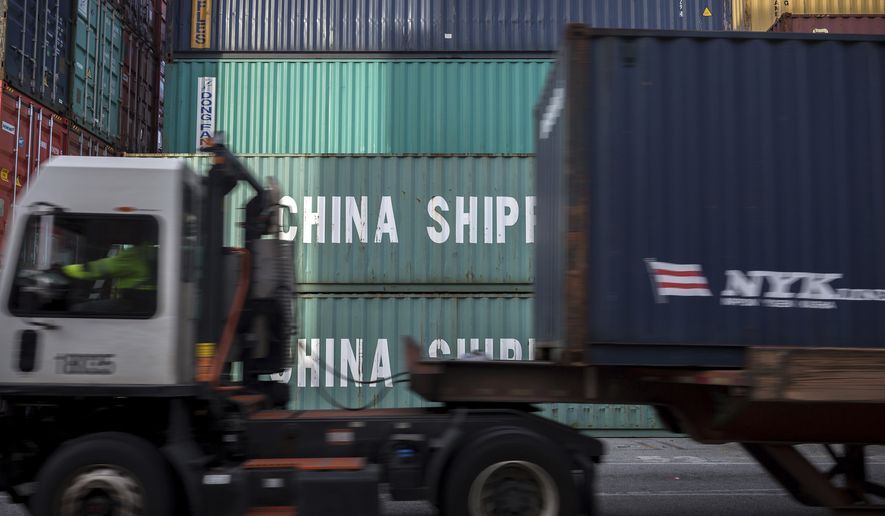

The trade war will between Washington and Beijing will be difficult for the U.S. to sustain as many tariff targets are produced by joint ventures in China, predicts one of China’s leading economists.
On Friday morning, the Trump administration followed through with a promise to impose tariffs on $34 billion worth of Chinese products, launching a trade war between the world’s two largest economies.
President Trump has framed the move as an effort to protect U.S. jobs and stop the “unfair transfers of American technology and intellectual property to China.”
People were interested in these podcasts
On Friday, China’s foreign ministry in Beijing immediately retaliated by imposing additional tariffs for U.S. products worth about $34 billion.
“But while the numbers appear staggering, U.S. action will in fact have little short-term effect on China’s economy,” former head of statistics at the People’s Bank of China, Sheng Songcheng, wrote in a Friday op-ed published by Caixin, an influential independent Chinese financial publication.
Mr. Sheng cited statistics from the Chinese Academy of Social Sciences, which suggested that the new U.S. tariffs are expected to reduce China’s export growth rate by only 0.75 percentage points. The negative impact on China’s gross domestic product growth — and Chinese consumer prices — is also expected to be minimal.
“This is because China’s economic growth is less dependent on international trade than it is on domestic demand,” Mr. Sheng wrote.
That factor, combined with estimates that “over $20 billion worth of China-made products being targeted by the U.S. tariffs are actually produced by foreign companies’ joint ventures in China” — will make a trade war “difficult for the U.S. to sustain,” the economist argued.
“Simply put, by opening fire at the rest of the world, the U.S. is also shooting itself in the foot,” Mr. Sheng concluded.
While China’s trade surplus with the U.S. is relatively large, it has also allowed U.S. consumers access to “cheap and relatively high-quality goods” essentially benefiting both countries, he noted.
In recent weeks many economists have said the tariffs imposed on Friday by both sides are counterproductive and could quickly hurt U.S. consumers most.
Mr. Sheng added that the U.S. has maintained a services trade surplus with China for a long time, which increased incomes in the U.S. and also promoted employment. Further tariffs could impact that, he warned.
Please read our comment policy before commenting.