



OPINION:
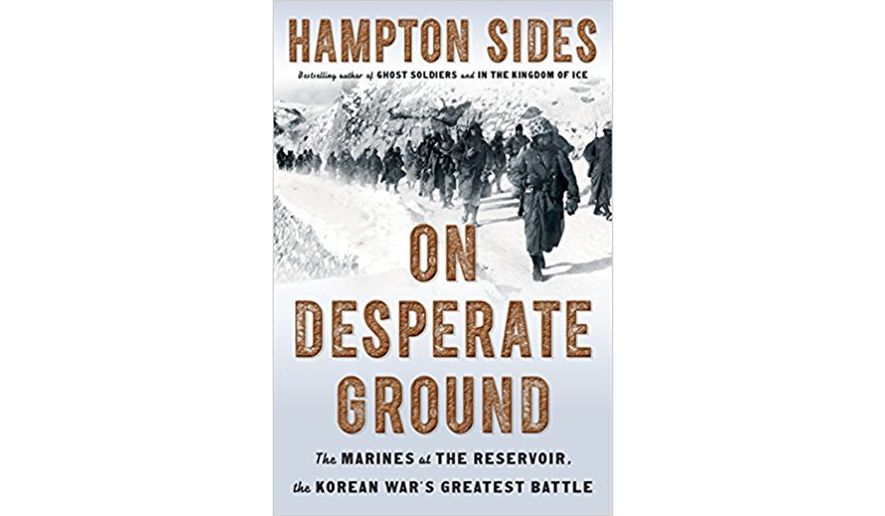
ON DESPERATE GROUND: THE MARINES AT THE RESERVOIR, THE KOREAN WAR’S GREATEST BATTLE
By Hampton Sides
Doubleday, $30, 398 pages
People were interested in these podcasts
On Oct. 15, 1950, early in the Korean War, President Harry S. Truman flew 7,000 miles to Wake Island in the Pacific to meet Gen. Douglas MacArthur, Supreme Commander for the Allied Powers, to ask one simple question: Was there any chance that China would intervene in Korea?
Gen. MacArthur was still savoring the total success of his perfectly executed amphibious landing at Inchon, where the First Marine Division with the help of Army units had routed the North Korean occupiers and moved quickly east to liberate Seoul, in the process also relieving units of the Eighth Army pinned down and taking heavy losses near Pusan, in the southeast.
With Kim Il Sung’s invading North Korean army suddenly cut off and rendered fangless, Gen. MacArthur envisioned yet grander triumphs. “He knew that his forces could easily cross the thirty-eighth parallel and destroy the last remnant of Kim’s retreating army,” writes Hampton Sides. “But why stop there? Why not seize Pyongyang? Why not drive all the way to the Yalu River, North Korea’s border with China, and unite the entire peninsula?”
“What a triumph this would be, what a blow against Communism, against Stalin, against totalitarian regimes everywhere.”
In Washington, writes Mr. Sides, with “the easy victory at Inchon, the mood had quickly turned from gloom to exhilaration.” Impending disaster had been suddenly transformed into potential triumph. “The Americans had Kim on the run. MacArthur had the firepower and the momentum, and he had the United Nations on his side. No more obstacles stood in his way.”
Gen. MacArthur was ready. He had total disdain for the Chinese as strategists and fighters, and they would never dare to intervene. And should they try, they’d be easily defeated. That is what he told President Truman, and that was the assurance the president sought. (In fact, current intelligence reports indicated that Chinese units were moving into North Korea. But Gen. Macarthur refused to acknowledge them.)
On his return to his headquarters in Tokyo, he found this communique from Secretary of Defense George Marshall waiting. “’We want you to feel unhampered tactically and strategically to proceed north of the 38th parallel.’” The document, Mr. Sides writes, “had been approved by President Truman.”
The plan, drawn up at Gen. MacArthur’s headquarters, was to split the forces, sending the Eighth Army to seize the capital of Pyongyang and then march up the western side of peninsula. The First Marine Division would board ships at Inchon, sail around the peninsula, make another amphibious landing at Wonsan, then march up into the mountains of Eastern North Korea, on a narrow twisting road to a manmade lake called the Chosin Reservoir, then on to the Yalu.
Gen. O. P. Smith, the Marine commander, disliked the plan. His division “would be strung along a narrow mountain road for nearly a hundred miles.” His supply line would be stretched, subject to severance at any point. One road in, and should the worst happen, one road out. And then the worst happened.
Some 300,000 white-clad Chinese soldiers, moving mainly at night, joined the battle at all points, defeating the Eighth Army and laying siege to the Marines at the Chosin, outnumbered and out-gunned, with their supply lines severed, in what would be one of the coldest winters in Korean history, with weather acting as “the third combatant.”
With a historian’s grasp of facts and a novelist’s narrative ability, Mr. Sides tells the gripping story of the Marine’s heroic stand, especially the men of the fabled Fox Company, against constant Chinese human wave attacks, suffering from frostbite, heavily wounded, fighting with rifles with red hot barrels, with bayonets, entrenching tools, rocks — this in the face of shrinking perimeters and diminishing supplies. Almost miraculously, they were finally relieved by their fellow Marines. They then fought their way south, bringing their equipment and all their wounded with them. And as they marched, we’re told, they broke into the Marine’s Hymn.
The Frozen Chosin has become Marine Corps legend, and more. (Because of such legends, many of us joined, and never regretted it.) As the military historian S.L.A. Marshall put it, “The Chosin Reservoir campaign is perhaps the most brilliant divisional feat of arms in the national history.” In military history generally, the Chosin breakout is viewed as a classic military retreat.
But at the time, Gen. O.P. Smith, who devised and oversaw the plan, saw it this way: “Retreat, hell. We are not retreating; we are just advancing in a different direction.”
Semper fi!
• John R. Coyne Jr., a former White House speechwriter, is co-author of “Strictly Right: William F. Buckley Jr. and the American Conservative Movement” (Wiley).
Please read our comment policy before commenting.