


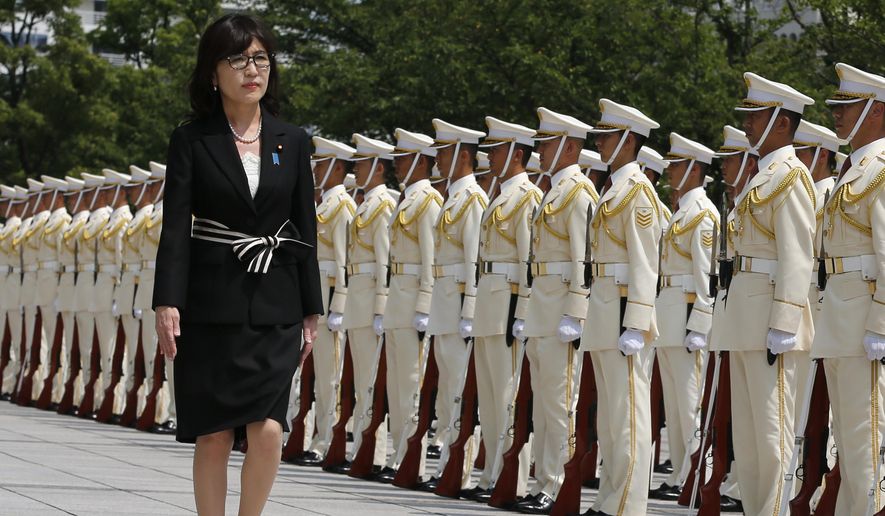

Japan will increase its military presence in the South China Sea through a series of “training” patrols in support of the U.S. and its allies through the hotly-contested waterways, new Defense Minister Tomomi Inada told a Washington audience Thursday.
But as Japan pursues ways to flex its military muscle against what it sees as Chinese aggression in the region, the country is also seeking a “candid discussion” with Beijing as a way to ease tensions in the Pacific, Ms. Inada added.
This dual-pronged approach is intended as a check to Beijing’s efforts to encroach on Japan’s sovereign waterways, while leaving an avenue for discussion once China decides to come to the bargaining table, according to Ms. Inada, who is considered a defense hawk as Japan engages in a major national debate over the future of its constitutionally mandated status as a “pacifist” nation.
People were interested in these podcasts
The patrols would be similar in nature to the “freedom-of-navigation” operations U.S. Navy vessels conduct regularly in the South China Sea, where Beijing has made expansive sovereignty claims in recent years. The training patrols envisioned by naval commanders in Tokyo would involve warships from the United States and South Korea, Ms. Inada said Thursday at the Center for Strategic and International Studies.
The Reuters news service reported that Japan this month signaled it was willing to provide new patrol ships to Vietnam, which is locked in its own battle with China over conflicting claims in the South China Sea. Tokyo also agreed to provide two large patrol ships and lend up to five used surveillance aircraft to the Philippines, yet another country at odds with China over sovereignty issues in the South China Sea, Reuters reported.
Ms. Inada — who is only the second woman to hold the top defense post in Japan — did note the American-led patrols were playing a key role in curbing China’s aggressive moves in the South China Sea.
Ongoing construction of Chinese naval outposts across the South China Sea, as well as repeated harassment of commercial vessels transiting the waterway, is Beijing’s effort to “attempt to change the status quo” in the Pacific for its own benefit, Ms. Inada said. “The consequences could be global and not just confined to the western Pacific,” she added, if other nations in the region don’t push back.
She declined to go so far as to lump in the new training patrols alongside the American-led missions in the region during Thursday’s speech, adding Japanese military leaders planned to re-evaluate the program’s success in the near future.
Tokyo is “continually examining if what we are doing is sufficient” to maintain stability and security in the Pacific, the Japanese defense chief said.
But just as important as displays of military strength are efforts to enhance diplomatic ties between Japan, China, the U.S. and its allies in the Pacific, Ms. Inada said.
“We will continue to keep open dialogue with China … and are committed to engaging and expediting negotiations” with Beijing to resolve the territorial disputes that have sent tensions soaring with countries throughout East Asia.
In July, an international arbitration court invalidated several of China’s territorial claims in the South China Sea in a case brought by the Philippines. Beijing has rejected the legitimacy of the ruling and established a de facto no-fly zone over a large portion of the sea in response.
It remains unclear how Beijing would react to the new training patrols militarily, but Beijing’s response to such American patrols has grown more hostile in recent months.
Chinese commanders in May ordered a team of fighter jets into the skies above the Fiery Cross reef near the Spratly Islands after the USS William P. Lawrence conducted a patrol close to the reef, which is also claimed by Taiwan, Vietnam and the Philippines.
The Washington trip, which included talks with Defense Secretary Ash Carter Thursday evening, was seen as an early test for Ms. Inada, who political observers in Tokyo could be emerging as a leading candidate to succeed Prime Minister Shinzo Abe. But her past hawkish statements and record have raised concerns not just in Beijing but in Seoul and other capitals in the region.
Please read our comment policy before commenting.