


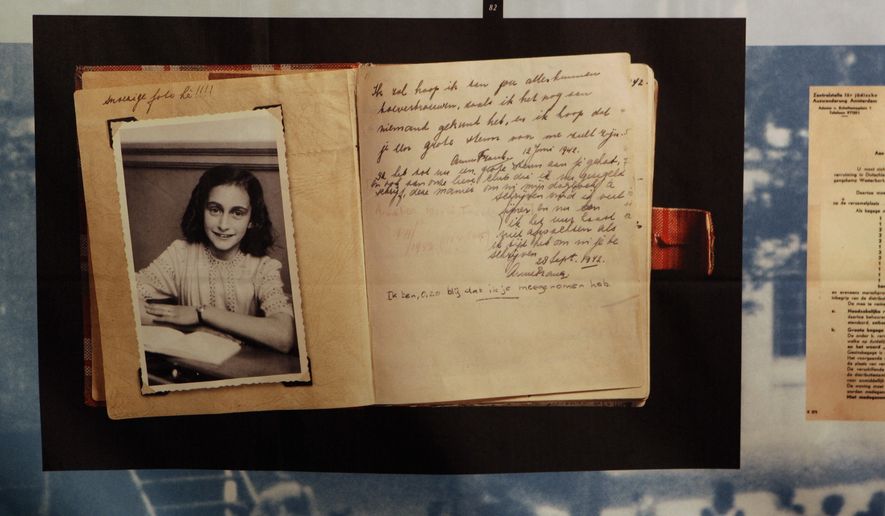

Holocaust researchers this week raised new questions about the events leading up Ann Frank and her family being captured by Nazis in 1944, casting doubts over the widely-held belief they were betrayed by an informant before being apprehended and interned at German concentration camps.
The executive director of the the Anne Frank House museum, Ronald Leopold, told reporters Friday that new research suggests Nazi secret police may not have been tipped off by an informant prior to finding the Franks secretly residing within an Amsterdam attic as generally accepted.
Instead, rather, he said that new research “illustrates that other scenarios should also be considered.”
People were interested in these podcasts
“In this new study, the Anne Frank House has not focused on the betrayal but on the raid itself: why did this raid take place, based on what information and from where did this information originate?” he said in a statement.
Though decades of reporting have suggested that Nazis discovered the Frank family’s secret hiding space with the help of an informant, Mr. Leopold said a new round of research has made it clear that no conclusive evidence exists to support that theory without a shadow of a doubt.
While an informant may indeed have betrayed the Franks prior to their capture on Aug. 4, 1944, researchers say the incident may have possibly materialized due to an investigation into either illegal labor or falsified ration coupons taking place at the residence beneath the attic where they lived in hiding for more than two hours.
Frank, a teenager, detailed the lengthy ordeal in a personal diary that was recovered and widely reproduced after she died inside a Nazi concentration camp several months later. According to the Ann Frank House researchers, her iconic journal includes references that suggest her family was well aware that two men who worked in the building beneath them had been arrested for dealing in ration coupons only a few months before her family’s hiding place was discovered.
“A company where people were working illegally and two sales representatives were arrested for dealing in ration coupons obviously ran the risk of attracting the attention of the authorities,” the report said.
Even if those arrests weren’t a tipping point, the researchers this week said it wasn’t entirely unusual for secret police to randomly come across other Jews similarly situated.
“During their day-to-day activities, investigators from this department often came across Jews in hiding by chance,” the report reads.
Nonetheless, the researchers behind the most recent study say the truth behind the events preceding the Franks’ arrest may indefinitely remain a mystery.
“The possibility of betrayal has of course not been entirely ruled out by this, nor has any relationship between the ration coupon fraud and the arrest been proven,” the report concluded. “Clearly, the last word about that fateful summer day in 1944 has not yet been said.”
Please read our comment policy before commenting.