



OPINION:
Although President Obama continues to assure the American people that the Islamic State, or ISIS, and other terrorist operations spawned in the chaos of the Middle East aren’t a real threat to the people of the United States, logic tells us that he may be wrong. The jihadists could at any time gain access to chemical, biological or even nuclear weapons and, if we are to believe their words, would be willing to use them.
In today’s world it wouldn’t take too many dedicated fanatics to create havoc and kill hundreds, thousands or even more. It only took a couple of dozen to bring down the World Trade Center in 2001 and not many more in recent days to wreak havoc in France, the United States, Mali, Lebanon, Nigeria, Afghanistan, Ethiopia, Pakistan and other places. Imagine what could happen in the future as their numbers increase substantially due to the homegrown radicals either operating on their own or in coordination with ISIS and the numbers even now infiltrating Europe and the United States by attaching themselves to the waves of refugees flooding into various countries.
In spite of the president’s assurances that neither the United States nor the world has much to worry about, it seems to most observers that the United States is currently offering neither a solution at home or the kind of the needed world leadership that Mr. Obama claims to be delivering.
People were interested in these podcasts
I am not sure who said this first, but it is right to the point: “A good leader inspires confidence in the leader; a great leader inspires people’s confidence in themselves.” Can we say honestly that this is the case with America nowadays?
Where is NATO in all this to fight ISIS, al Qaeda and affiliates? It keeps expanding and demanding more money, but doesn’t seem anxious to get into the fight against terrorists in Afghanistan, Iraq and Syria.
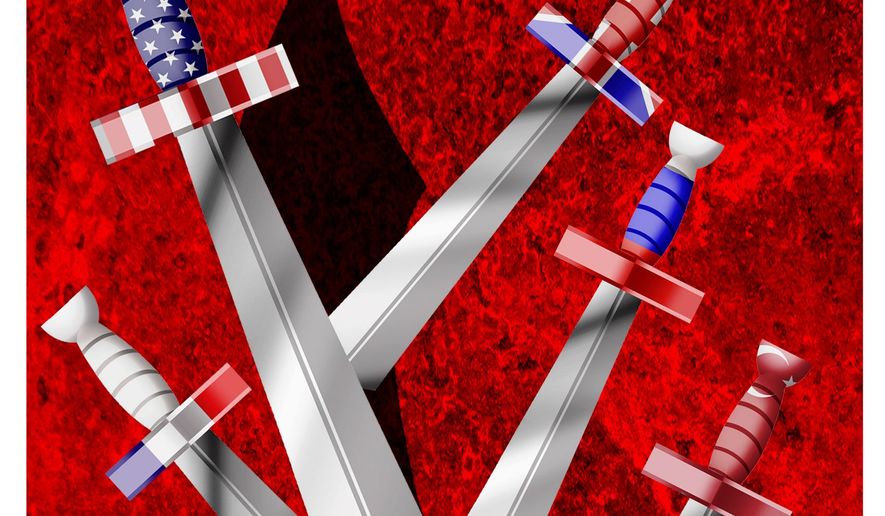
Meanwhile Turkey, a NATO member, continues to defy Washington and Brussels by openly helping the jihadists and attacking the Kurds, who are among the few groups prepared and capable of fighting ISIS on the ground. To make matters worse, a Turkish force has even invaded Iraq, which is supposed to be an ally in the struggle to defeat ISIS.
The existential question remains, “What do we do?”
The president and his critics differ on how to handle the immediate threat within the nation’s borders, but the National Security Agency, FBI, Department of Home Security and many other agencies whose job is to protect us from terror have the tools to do so.
The real question involves the best way to proceed on the international front. It would seem wise to form a real and not a fake anti-terrorist coalition involving the United States, the EU, Russia and possibly even China with their respective allies, who are ready to tackle the problem rather than hope for some miracle.
British member of Parliament and former London Mayor Boris Johnson said recently: “This is the time to set aside our Cold War mindset. It is just not true that whatever is good for Putin must automatically be bad for the West. We both have a clear and concrete objective — to remove the threat from ISIS. Everything else is secondary.”
Similar statements have come from French and Italian leaders, Germany’s foreign minister and even some prominent Americans like former Secretary of Defense Chuck Hagel, Rep. Dana Rohrabacher, Democratic presidential candidate Bernie Sanders and, if I understand his words correctly, the current GOP front-runner, Donald Trump.
Even Secretary of State John Kerry during his Dec. 15 meeting with Vladimir Putin in Moscow suggested that the United States and Russia might be able to come together in the face of ISIS when he said, “The United States and our partners are not seeking regime change in Syria. We see Syria fundamentally very similarly,” Mr. Kerry said. “We want the same outcomes, we see the same dangers, we understand the same challenges.”
Every nation has its own national interests and agenda, but in today’s world as during World War II, nations with differing interests but facing a common threat can and must get together to eliminate it. U.S. leaders cannot go it alone in the battle against the current jihadi threat and shouldn’t want to; the United States can and should commit to working with all of those nations willing to help shoulder the burden of defeating ISIS before we all end up facing an enemy using weapons we cannot even imagine.
There are some who think that it is too late and the train for our civilization as we know it has left and is hurtling downhill to the abyss. But an American leader with vision can inspire the American people and the world to rise up and protect that which we all hold dear.
• Edward Lozansky is president of the American University in Moscow and a professor at Moscow State and National Research Nuclear Universities.
Please read our comment policy before commenting.