


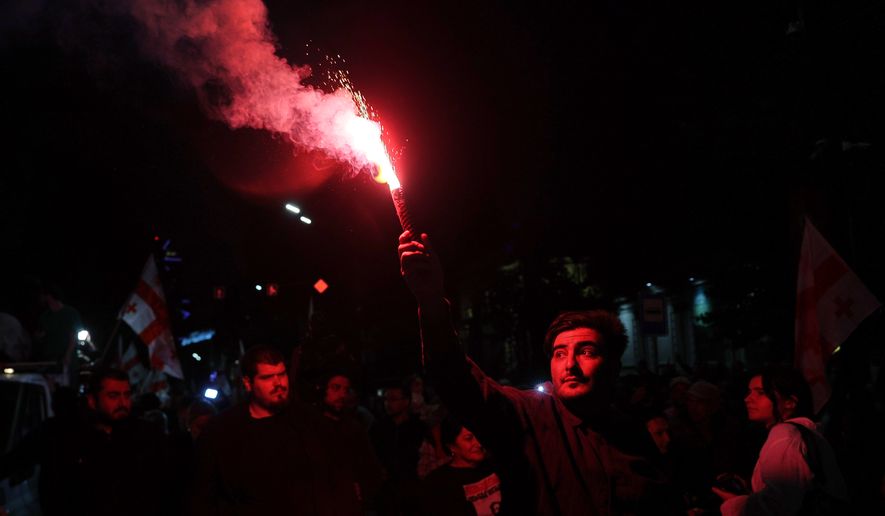

ODESA, Ukraine — Georgia’s Independence Day last month was supposed to be a historic display of national unity for the nation of 3.9 million. Instead, May 26 highlighted the growing rift between Georgian society and the country’s increasingly authoritarian ruling regime.
As the government staged military ceremonies and spoke of national sovereignty, thousands of protesters marched in the streets of the capital, Tbilisi, waving Georgian and European Union flags and carrying signs denouncing the government’s corruption and repression.
Their message was crystal clear: Georgia’s independence can only be secured through further integration with the West and the European Union.
The May 26 demonstrations were the latest sign that Georgia’s political crisis isn’t fading anytime soon. More than a year after mass protests first erupted against the ruling Georgian Dream party, the streets remain defiant, while the country’s once-promising path toward the European Union is frozen.
Georgia’s fifth president, Salome Zurabichvili, says the stakes couldn’t be higher, as the upcoming months will determine whether Georgia remains a free European democracy or drifts into Russia’s sphere of influence.
“The future of Georgia is European, democratic and very clearly independent,” Ms. Zurabichvili told The Washington Times. “That is the absolute red line.”
Ms. Zurabichvili, who led Georgia from 2018 to 2024, refuses to recognize Mikheil Kavelashvili, the Georgian Dream-backed former soccer player who replaced her after a disputed process. Many Western officials consider Ms. Zurabichvili to be Georgia’s legitimate head of state, and she remains one of its most visible pro-European figures.
Her role now, she said, is to speak for a society that is being silenced.
“My role is to consolidate Georgian society around its own vision of the future,” she said. “Outside the country, my role is also to be the voice of this society, which practically no longer has a voice. The embassies serve the party.”
While small, Georgia possesses outsized strategic value because of its location: The country sits on the Black Sea, borders both Russia and Turkey, and anchors the Caucasus corridor linking Europe to Central Asia.
It also remains among the most pro-Western societies in the former Soviet space, which is what makes its current political crisis a matter of great concern to both Washington and Brussels.
For years, Georgia was seen as a success story: Despite having fought a war with Russia in 2008 and lost control of the breakaway regions of Abkhazia and South Ossetia as a result, the country still pushed toward the West.
Its constitution commits the country to European Union and NATO integration, and opinion polls have repeatedly shown broad support for joining the EU.
After promising further EU integration however, Georgian Dream abruptly changed course.
Founded by billionaire Bidzina Ivanishvili, the party came to power in 2012 without openly challenging the country’s Western orientation. But after Russia’s full-scale invasion of Ukraine in 2022, the government grew more hostile toward the West and repeatedly accuses its critics of trying to drag Georgia into war.
The rupture with Brussels became official in November 2024.
After parliamentary elections rife with fraud were rejected by the opposition and criticized by Western partners, Prime Minister Irakli Kobakhidze said Georgia would not put EU accession talks on the agenda until the end of 2028. The government also said it would refuse EU budget grants until then.
Georgian Dream boasted of its defense of national sovereignty against European “blackmail.”
As a result, the European Commission says Georgia’s accession process has effectively come to a halt. High-level political contacts have been downgraded, while aid flowing directly to the Georgian authorities has been reduced. Support for civil society and independent media, on the other hand, has increased.
In March, the EU suspended visa-free travel for Georgian diplomatic, service and official passport holders. Ordinary citizens were spared, a clear attempt to distinguish between the ruling elite and society at large.
Washington has sharpened its tone as well.
After an Organization for Security and Co-operation in Europe report detailed abuses in Georgia, leaders of the bipartisan Helsinki Commission accused Georgian Dream of robbing the Georgian people of their “hard-won freedom” and turning the country into an “isolated, authoritarian state.”
They called for political prisoners to be freed, repressive laws to be repealed and sanctions to be instituted against the individuals responsible for enacting them.
On the ground, the crackdown has intensified in recent months.
Georgian Dream has adopted a controversial “foreign influence” law that critics have compared to the Russian legislation used by Vladimir Putin’s regime to crush civil society and opposition parties.
The party has pushed new restrictions on foreign grants, political activity and independent organizations and has moved toward banning major opposition parties.
The courts have followed suit.
In May, 10 people, including opera singer and activist Paata Burchuladze, were sentenced to prison over protests linked to the October 2025 municipal elections. Five received seven-year sentences. Four others received five years.
In March, opposition leader Elene Khoshtaria was sentenced to 18 months in prison for writing “Russian Dream” on a Georgian Dream campaign banner. Amnesty International called the case politically motivated.
One 61-year-old protester, Zurab Menteshashvili, was sentenced to nine months in prison for blocking a road during an anti-government rally.
Ms. Zurabichvili says the increasing repression isn’t a sign of confidence, but rather is betraying the ruling party’s fear of its own society.
“The mobilization continues to be one of the ways forward,” she said. “It bothers the authorities a lot. Otherwise they would not invent new measures every day to repress and prevent it.”
She said the campaign has so far failed to break the protest movement.
“Among the prisoners of conscience, no one has cracked, no one has asked for forgiveness,” she said. “Fear no longer works on the population.”
The Independence Day rallies, she said, proved that street rallies still matter.
“The direct threat to the regime is its own weakness,” she said. “Fear has moved to the side of its supporters.”
Ms. Zurabichvili traces Georgian Dream’s turn away from Europe to the period before Russia’s 2022 invasion of Ukraine. Until 2021, she said, the ruling party did not openly contradict Georgia’s pro-European course. Then came the break with EU mediation, the rejection of budget aid and the increasingly anti-Western message.
She sees Moscow’s hand behind the shift.
“Russian influence operations have existed,” she said. “They do not need to influence Georgian Dream, since they have a leader who, for reasons I do not know, is in their hands.”
She said Russia also influenced Georgia’s highly-contested 2024 parliamentary elections, using call centers to hammer the ruling party’s messaging and sending experienced political advisers.
The next test for the future of Georgian democracy, she said, will be the next elections.
“We can predict that there will be elections in this country, but not under what conditions,” she said. “Maybe the weakened regime will implode at some point. Maybe it will decide that it is better to organize elections while it still controls the essentials. Or maybe we will go to the normal deadline.”
Either way, she said, the West must prepare now. “In any case, we will have to prevent, help and observe,” she said.
Old methods, she warns, will not be enough.
“The OSCE observations of the last century no longer work,” Ms. Zourabichvili said. “We are in another world. Artificial intelligence is also being used.”
She said she had personally been targeted by manipulated videos showing her speaking Russian, a language she said she does not speak, with her own voice.
That warning will sound familiar far beyond Georgia.
The same tools of political pressure, disinformation, lawfare and election manipulation are being tested across the democratic world. In Georgia, they are colliding with a pro-Western society on Russia’s southern flank.
For Moscow, the stakes are obvious.
“For Russia, if one holds Ukraine, Romania and Georgia, the Black Sea becomes a lake,” Ms. Zurabichvili said. “If one holds the Caucasus, one holds the corridor that connects Europe to Central Asia.”
That corridor matters more than ever. As Europe tries to reduce dependence on Russian routes and energy, Georgia is part of the emerging Middle Corridor connecting Europe, the South Caucasus, the Caspian Sea and Central Asia.
One way or another, the resolution of the ongoing political crisis will resonate far beyond Georgia’s borders.
A stable, free and democratic Georgia would strengthen the Black Sea region and protect a vital route between Europe and Central Asia. It would also deny Russia another foothold at a time when Moscow is trying to bully its smaller neighbors, such as Armenia, into rejecting further EU integration.
While Georgians keep fighting for democracy and a pro-Western foreign policy, the question now is whether the West will help them.
Please read our comment policy before commenting.